
Sweet in bee minor

I have a little thing in the March edition of The Monthly on bees, pollination and the slow encroachment of doom. Here’s a snippet. More in shops and online at The Monthly next week.
Paying slightly closer attention now, I realise how much I let nature’s patterns blow over me before. I’ve lived in the climatic moment, today’s weather being replaced, perhaps with a little forecasted foreknowledge, by tomorrow’s. It’s a limited view, but one that we are tuned for as fundamentally urban people, living in a world built against nature rather than one tuned to the detail of its present, never mind its mid- and long-term vagaries. Which is not to say that I haven’t taken a keen and pretty close interest in my environment. For years I’ve walked, hiked, camped and gardened. I’ve immersed myself often in the natural outdoors, but have perhaps been too intent on seeing it as a series of vistas and captivating vignettes, and not as a complex mesh of interrelated systems and beings. There’s a difference there, between a world presented for aesthetic appreciation and one that might be the subject of a more open-ended and consequential enquiry.
A project to grow more vegetables has also brought me closer. This is gardening with a quantifiable endpoint: the production of food. It has no liminal space between success and failure that might be filled by simple prettiness. You either get a crop of brussels sprouts after a six-month process of assiduous husbandry, or you don’t. (The possums got mine last winter. Much heartache.)
Between bees and vegetables, I’ve been led to a steadier, deeper, natural observation: a pursuit of some kind of intimacy with place. I read that great narrator of nature, William Wordsworth, and in his words sense a view in which beauty coexists with something more serious: a world in which we might wander lonely as a cloud enraptured by the dancing daffodils, while also seeing about us elements that evoke “Characters of the great Apocalypse / The types and symbols of Eternity”.
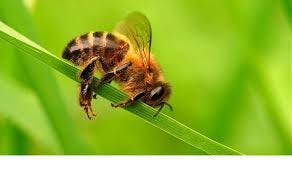
A foraging honey bee can pollinate more than 5000 flowers a day. A hefty colony includes as many as 50,000 bees, so the number of pollinated flowers quickly multiplies. Pollination is an untended consequence of routine bee life. The honeybee collects pollen and nectar from the flowers for food, but pollination from flower to flower is a happy accident brought about by the pollen attracting properties of a small, vibrating, furry body. That vibratory buzz, the bee note produced by rapidly oscillating muscles of the thorax, is around 200 to 260 hertz, or close enough to middle C, at 261.63 hertz. This is a factoid of no consequence to the flower, which simply yields its pollen to the humming body of the insect regardless of precise, tempered pitch.
What a touching read…I’m amazed by these incredible creatures.
Living two stories up they still find the flowers of my lavender, thyme, oregano, tomatoes and basil.
Today I rescued a bee from the swimming pool which was clinging on for dear life on one of the lane floats. I watched this creature fastidiously “dry” itself off for well over five minutes. Each leg, lifting its bum up, antennae, wings outstretched, making sure all traces of moisture were gone. Once done it flew off.
That brought me such joy.
Yes, they are bloody good.
I love your writing Jonathan, please keep doing it. Bees are bloody good aren't they?